Buyers guide
How to buy a pre-owned watch on Grail Flex
What we’d tell a friend before they bought one: how the marketplace works, what to check, how to read a price, and when to walk away.
How Grail Flex works
Grail Flex is a marketplace. We don’t own the watches listed here. Every one is offered by a professional dealer, and you deal with them directly.
Dealers only
There are no private sellers on Grail Flex. Dealers apply, our team reviews the business, and only then can they list. If you own a watch and want to sell it, that’s a Sale Request, not a listing.
The Grail Verified badge
Grail Verified means we’ve confirmed the dealer’s business credentials. It’s a statement about the business, not an inspection of the individual watch, and not every dealer has it yet. You can filter search to Grail Verified dealers or browse all dealers.
Every listing sits on a real reference
Dealers list against our catalogue of brands, models and reference numbers, so the specifications on a listing are the manufacturer’s, not the dealer’s typing. A dealer can override a spec when a watch genuinely differs, say a vintage dial that’s faded to brown. If a listing’s specs don’t match its reference, ask why.
Photos are of the watch you’re buying
Listing photos are uploaded by the dealer and should show that exact watch, not a catalogue image. Some listings carry a note under the photos about where they came from. Read it, and if you’re serious, ask for fresh photos of the case back, clasp and any papers.
Enquiring and paying
You message the dealer from the listing, agree the deal with them, and pay them directly.
Message the dealer
Every listing has a message box that goes straight to the dealer. You’ll need a free account. Your conversations are kept in My Account, so the dealer’s answers about condition, history and terms stay on record. Listings marked Price on request work the same way: ask, and the dealer will tell you.
Paying for the watch
Grail Flex doesn’t take payment for watches. You and the dealer agree the price, payment method, delivery and returns between you, and you pay the dealer. That also means we don’t hold your money and have no record of the final sale, so we can’t step in if something goes wrong after you’ve paid. Treat it like buying from any dealer:
- Pay the business, into an account in the business’s name. Never a personal account, crypto or gift cards.
- Get a tax invoice that lists the watch’s reference and serial number.
- Prefer methods with some recourse. A credit card may give you chargeback rights a bank transfer doesn’t; some dealers add a surcharge for it.
Delivery, returns and warranty
These are set by each dealer, so get them in writing in your conversation before you pay. Ask how the watch is shipped and insured, whether a signature is needed on delivery, how long you have to return it and in what condition, and what warranty comes with it. If you can, inspect it in person at the dealer’s premises.
If you’re buying from an Australian business, the consumer guarantees under the Australian Consumer Law (opens in a new tab) may apply to second-hand goods too, allowing for age and condition. We’re not giving legal advice; check the ACCC for your situation.
Can’t find it?
Send a Sourcing Request and our team and dealer network will look for it. It’s free and you’re not committed to anything. Or save a search and turn on a Grail Alert, and we’ll tell you when a match is listed.
Condition and what’s included
Every listing carries two separate labels: how worn the watch is, and what comes with it.
Condition
From least to most worn. These are a guide to how dealers generally use the grades; the dealer’s description and photos are what you’re buying against.
- NewNever sold to an end customer. Stickers and protective film usually still on.
- UnwornSold at retail but not worn. Expect the same as new, with an earlier warranty start date.
- Very goodWorn with care. Light marks you’d need to look for, no dents or deep scratches.
- GoodNormal signs of wear: visible scratches on the case and bracelet, possibly some light dings.
- FairHeavy wear, and it may need work. Budget for a service or refinishing.
- IncompleteMissing parts or not running. A project or parts watch, priced accordingly.
Scope of Delivery
What comes in the box with the watch. It says nothing about condition.
- Full set
- Original box and papers (the warranty card or certificate). The easiest to resell and usually the most expensive.
- Watch & box
- The box came along, the papers didn’t. Fine for wearing; it can cost you at resale.
- Watch & papers
- Papers but no box. Papers matter more than the box for most references.
- Watch only
- Just the watch. Often the best value for a keeper, but lean harder on the dealer for provenance.
Go over the watch
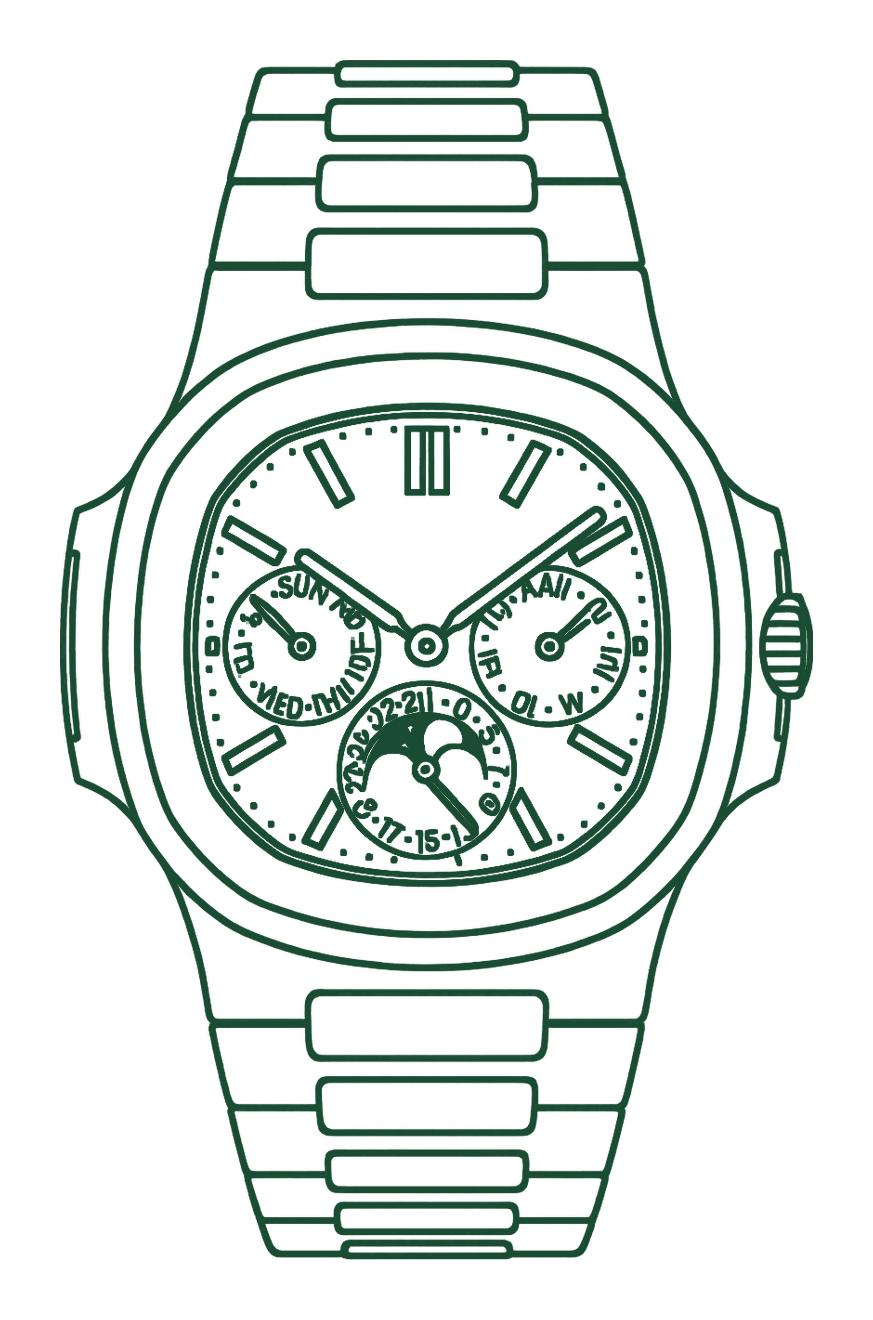
Whether it’s in your hand or on your screen, work around the watch in the same order every time.
- 1
Dial and hands
Printing should be crisp and evenly spaced. Lume on the hands and markers should have aged the same way; a bright white set of hands on a creamy dial usually means the hands were replaced. Check for dust or moisture under the crystal.
- 2
Bezel and crystal
Look for chips, fading or a cracked insert, and ask how the bezel turns. A dive bezel should click firmly one way with no play. Small scratches on sapphire are rare, so marks there are worth asking about.
- 3
Case and lugs
Sharp edges and crisp transitions between brushed and polished surfaces mean the case hasn’t been polished heavily. Soft, rounded lugs and thinned bevels mean it has, and that’s metal you can’t put back.
- 4
Crown and pushers
A screw-down crown should thread in smoothly. Ask whether the crown and pushers are original or service replacements, and whether the watch was pressure tested at its last service.
- 5
Bracelet and clasp
Hold the watch sideways: a tired bracelet sags between the links. Ask how many links are left in the box if you have a bigger wrist. The clasp should close firmly and its code should suit the watch’s year.
Then turn it over. The case back and serial number should match the papers, and the movement should be the calibre the reference calls for. Ask the dealer for a timegrapher reading or a week of timekeeping on the wrist. A healthy automatic will typically run within a few seconds a day.
Originality, papers and service
Two watches with the same reference and grade can be worth very different money. Usually the difference is here.
Originality
Brands often fit new dials, hands or bezels during a service. That keeps a watch running well but can take value off a collectable reference, so ask whether any parts were replaced and whether the originals came back with it. Aftermarket parts, like added diamonds, a non-factory bezel or a refinished dial, take value off almost every watch.
Papers
Papers are the warranty card or certificate issued when the watch was first sold. Check that the serial number on them matches the case. Papers help resale and provenance, but they can be faked too. They support a watch’s story; they don’t prove it on their own.
Service history
Ask when the watch was last serviced, by whom (the brand or an independent watchmaker), and whether there’s an invoice. “Recently serviced” with no paperwork is just a claim. If a service is due, find out what it costs for that brand and count it as part of the price.
Reading a price
The price on a listing is the dealer’s starting point. Here’s how to read it.
List price and your currency
Dealers set a list price in their own currency. If you browse in a different currency, the figure you see is an estimate converted for convenience; the listing shows the dealer’s actual list price underneath, and that’s the number your deal is based on. Exchange rates move, so confirm the final amount in writing.
Compare like with like
Open the reference page for the watch (the reference number in a listing’s breadcrumb, where it appears) to see every current listing of that reference side by side. If there’s no reference link, the model page in the breadcrumb lists every example of that model. Then adjust for what’s different:
- Scope of Delivery. A full set usually costs more than watch only, and holds that premium at resale.
- Condition and polishing. An unpolished case is worth more than a heavily polished one in the same grade.
- Year and dial. Within one reference, particular years and dial variants can carry a premium.
- Service. A fresh brand service with paperwork is money you won’t spend for a while.
Making an offer
Dealers expect questions and many expect an offer. Make yours in the conversation and say what it’s based on: comparable listings, a service that’s due, a missing box. Specific reasons get specific answers.
Red flags
Any one of these is reason to slow down. Two or more is reason to walk away.
Price well below every comparable listing. Great watches at a big discount are rare, and dealers know what they have.
Pressure to pay today. “Another buyer is waiting” is a sales line. A good dealer will let you ask your questions first.
Payment details that don’t match the business. A personal account, a different company name, crypto or gift cards.
Reluctance to send more photos or a video. Ask for the case back, clasp and papers with today’s date on a note beside them.
Serial numbers that don’t line up. The serial on the papers and invoice should match the watch.
Parts that don’t suit the reference. A dial, bezel or hands that don’t match the reference, with no explanation.
Vague history. “Recently serviced” or “just like new” with nothing on paper to back it up.
Wanting to move the conversation elsewhere early. Keep discussions in your Grail Flex conversation so the details stay on record.
Questions to ask the dealer
Copy these into your message. A dealer who answers all of them clearly is worth buying from.
- Can you send photos of the case back, clasp and papers, plus a short video of it running?
- Has the case been polished? Are the dial, hands and bezel original?
- When was it last serviced, and by whom? Is there an invoice?
- What exactly comes with it, and does the serial on the papers match the case?
- How do you take payment, and will I get a tax invoice with the serial number?
- How will it be shipped and insured?
- What’s your returns policy, and what warranty comes with the watch?
Ready to start looking?
Search every listing, or narrow it to dealers we’ve verified. If it isn’t listed, we’ll go and find it.